Found it, and fixed it. Putting the panel back on cured the sea readings but never restored the charging — and the reason was not the panel. It was the wire. Clamped under the panel it never flexes at all, but on the night the hatch was open it hung in the swell for nineteen hours, and the conductor cracked inside its own insulation. She ran the battery flat on Monday lunchtime. She is repaired and goes back in the water shortly. The full postscript is at the end of this piece →
A day in the life of a buoy
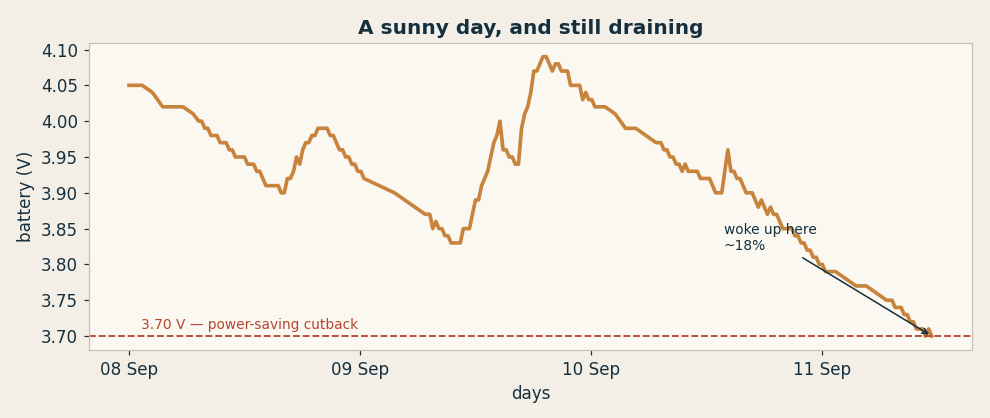
I woke up, checked the buoy over coffee, and found her limping on 18% battery on what should have been a bumper solar day. An hour later I knew exactly what was wrong — before I'd even pulled the cover off the jet ski. Here's how the data told the whole story.
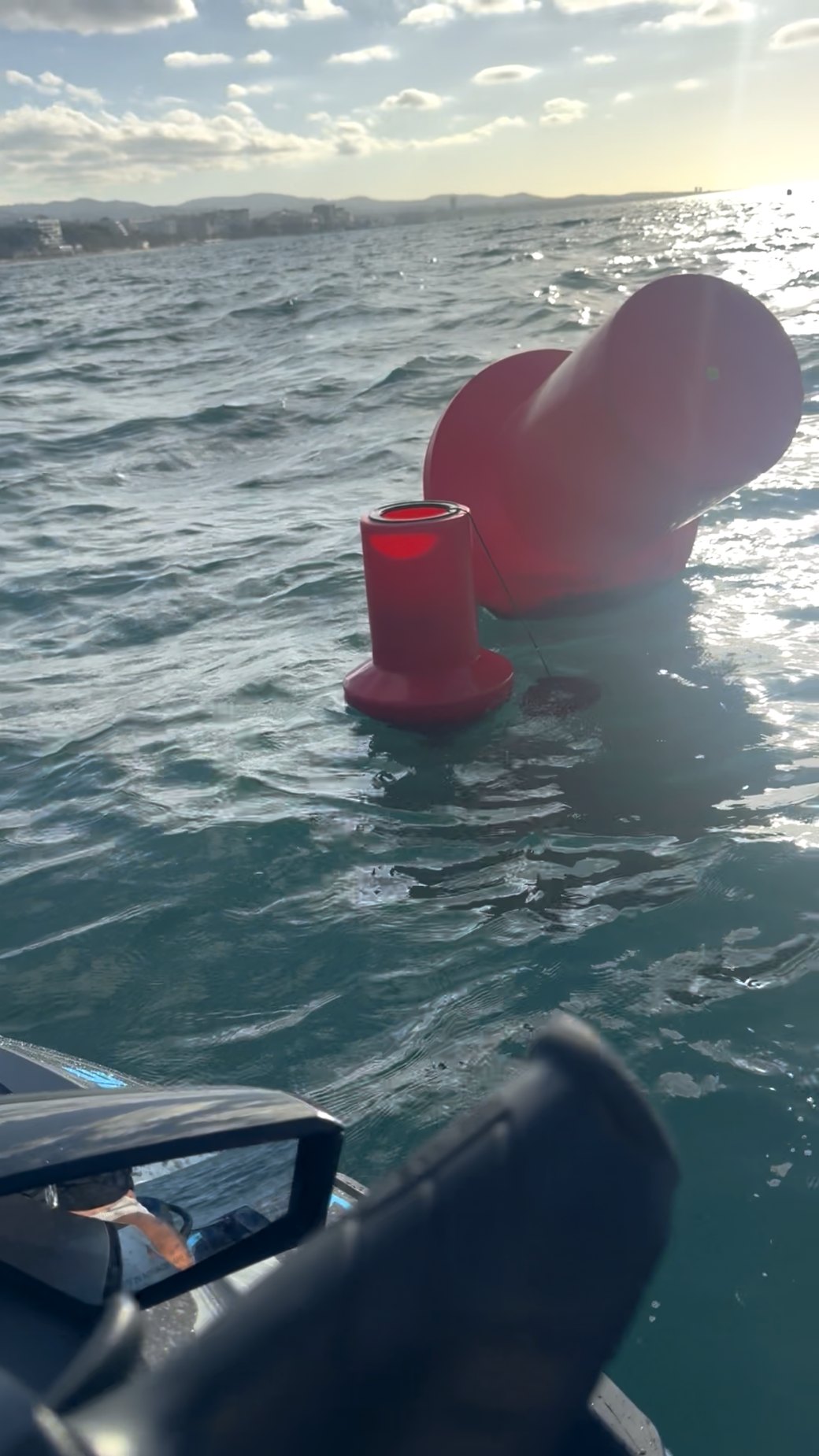
18%, on a sunny day
First thing every morning I glance at the dashboard. This time it stopped me mid-coffee: 18% and still sliding. I tried nudging the charge; nothing. On a bright Costa del Sol morning a healthy buoy tops itself up — it doesn't quietly run down. Something was off.
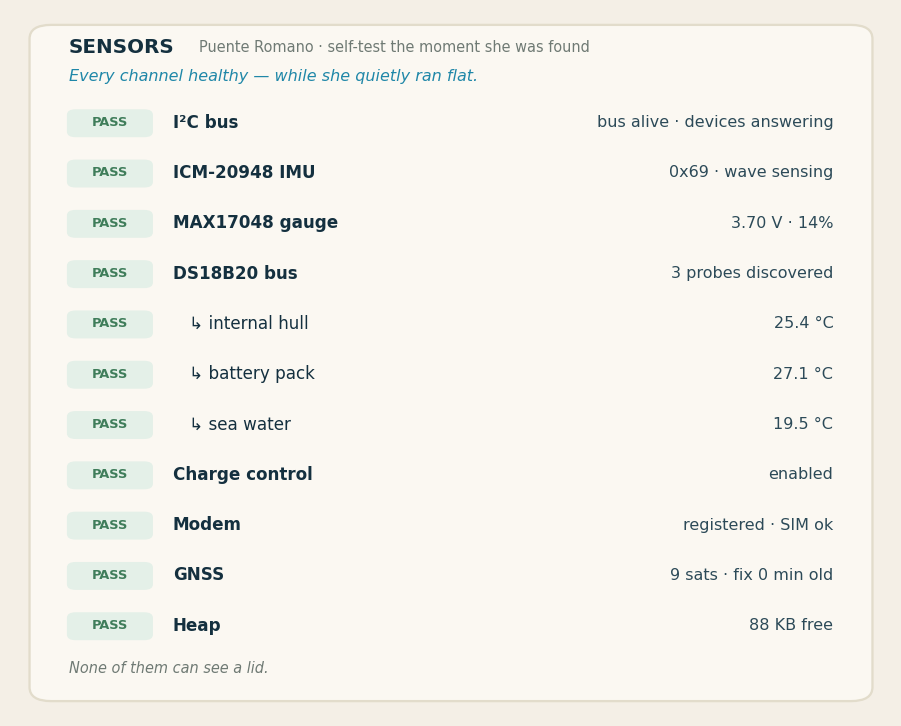
But every sensor swore it was fine
My first worry was a dead sensor, so I opened the health panel. Every channel green — the motion sensor, GPS, battery gauge, all three temperature probes, the radio, the lot. Which is the confusing kind of broken: the instruments all insist "I'm fine" while the whole unit slowly flatlines.
The AI's first guess — which was wrong
I asked Marola's assistant what it made of it. Its first answer: "probably just a cloudy day — weak solar." Reasonable. Except it was gloriously sunny, and I could prove it without a weather app: the buoy's own body had baked to 46 °C inside the day before, and 43 °C that very morning. You don't cook a sealed dome that hot under cloud. So "cloudy" was off the table. Even a clever assistant needs the right question pointed at it.
The one number nobody had looked at
Here's the thought that cracked it. The solar panel sits right on top of the buoy, on the hatch lid. If that lid had popped and the panel had flopped into the sea, three things would happen at once: we'd stop charging; the inside of the buoy — a big sealed air space that normally roasts like a parked car — would suddenly go cold, because the greenhouse is gone; and the panel, now dangling on its cable, would tug the electronics box on every wave, so the motion sensor would start talking nonsense.
So I asked the AI to pull the internal hull temperature — and there it was.
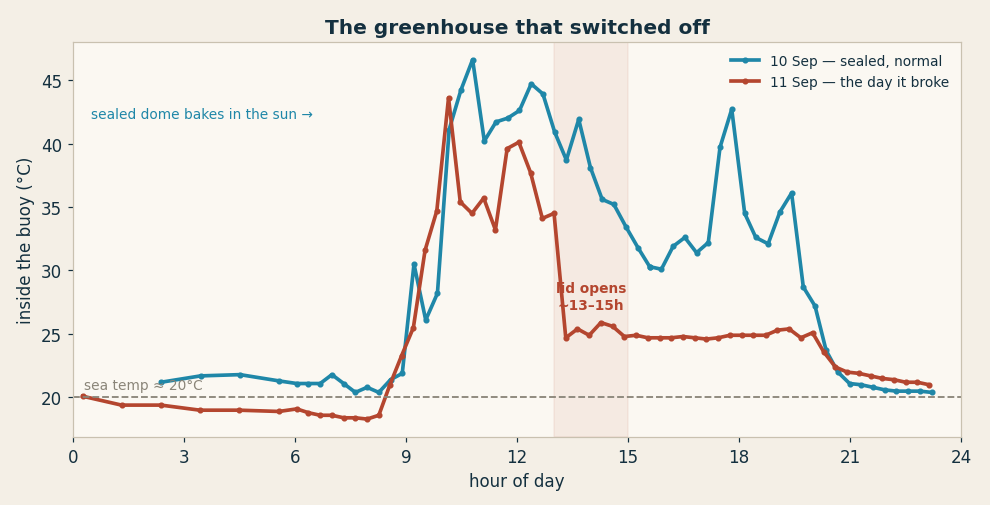
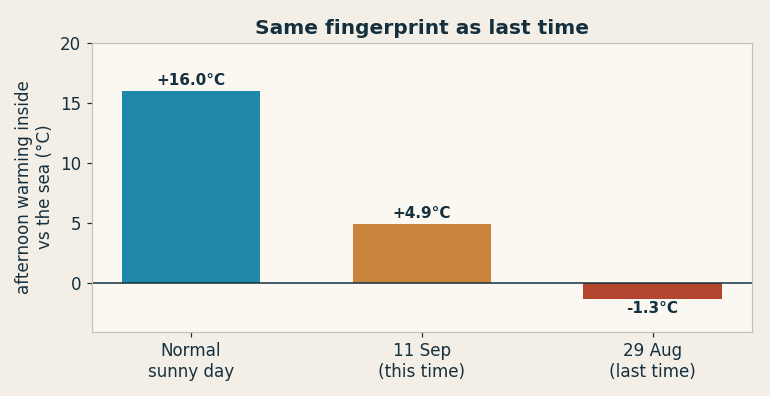
All morning the inside behaved normally, climbing past 40 °C like any sunny day. Then at about 1pm it fell off a cliff — down twelve degrees and flat as a board near sea temperature for the whole afternoon, while the day before it had stayed hot till dusk. The lid was open.
And sure enough, the sensor was lying
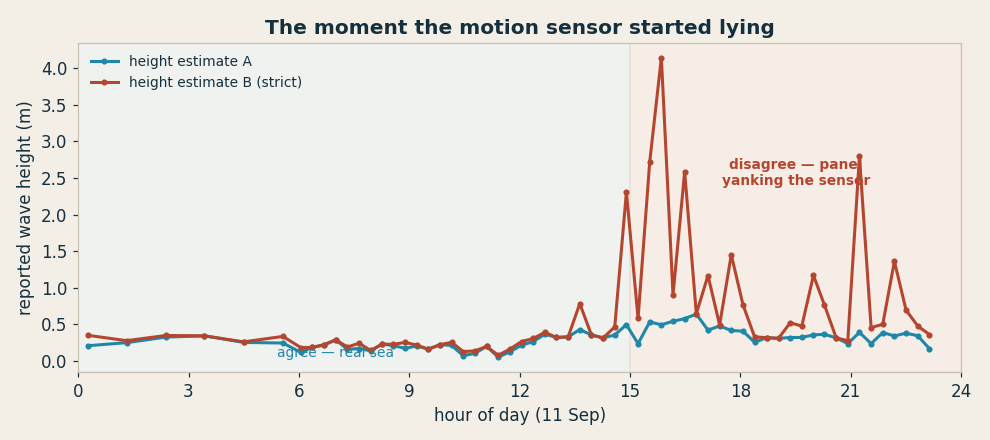
The motion sensor sealed the case. Two independent wave-height estimates that had agreed all morning suddenly flew apart after 1pm — one reading a calm half-metre, the other spiking past four metres on a flat sea. That's not the ocean. That's a solar panel hauling on the electronics with every swell.
We'd met this ghost before
This wasn't the first time. Back in late August the same thing happened, and the temperature signature was even more extreme — the inside actually dropped below sea temperature. Same fingerprint, same cause. Having seen it once, we recognised it in a single afternoon this time.
The best part: I knew the fix before I left the dock
This is the bit I love. I hadn't laid a finger on the buoy — I was still on the sofa. But between the flat battery, the cold hull and the lying motion sensor, the diagnosis was certain: the hatch had opened and the panel was in the water. No mystery to unravel at sea, no bobbing around poking at things. Just go out, reseat the panel, shut the lid.
So I did the only responsible thing and took the jet ski out to fix it. A terrible chore, first thing on a sunny morning.
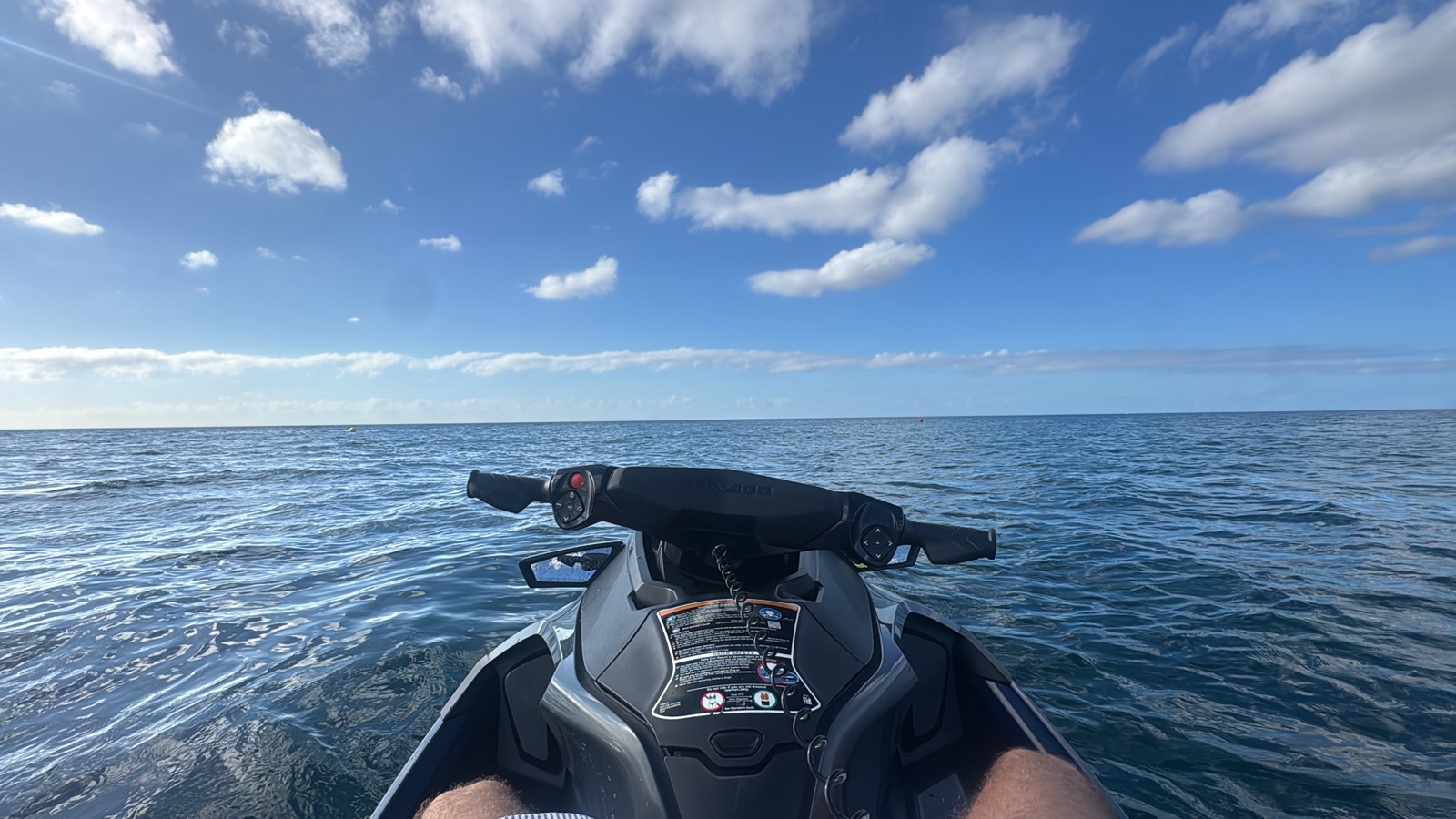
And there she was, heeled over, exactly as the numbers had promised — the hatch wide open, the panel in the water.
Panel back in its seat, lid closed, and she was charging again within the hour.
Now, to stop it happening again
The lid is a standard hatch, and standard hatches, it turns out, work themselves undone. So we're going to secure it properly. The theories for why it keeps opening, roughly in order of suspicion:
- It's getting knocked. She's tethered to a bigger flotation buoy, and every time the two clash in a swell, the neighbour may be nudging the hatch loose. This is our lead suspect.
- Curious hands. It's an accessible mooring; someone may simply be opening it.
- Pressure build-up. A hot sealed dome could in theory pop its own lid — but at these temperatures it seems unlikely.
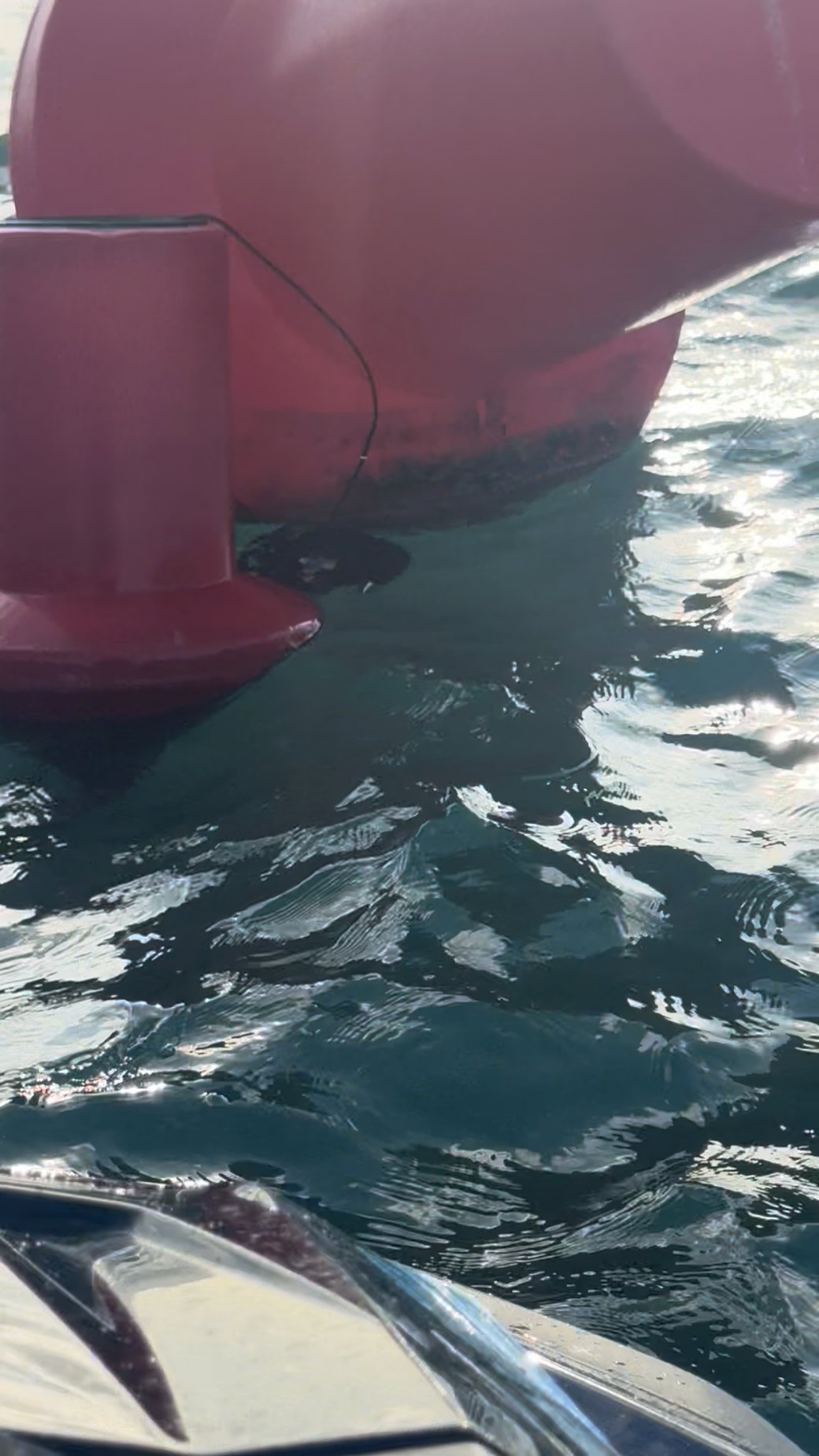
Next: a positive latch that can't be shaken loose, and probably a bit more separation from the neighbouring buoy so they stop head-butting. And if that internal temperature trace ever goes cold at midday again, we'll know within the hour.
The buoy can't say "my lid is open." But listen to everything else she tells you — how warm she is, how well she's charging, how much she trusts her own senses — and she tells you anyway.
The fix that didn't fix it
Reseating the panel worked — for the sea. From that afternoon on she measured the water beautifully: the two height estimates agreed again, the hull warmed up like a sealed dome should, every ghost in the story above simply went away.
She just never charged. Not a milliamp. Day after sunny day the battery went one way only, and on Monday she ran out of it — one last reading at 13:38 on 14 September, 2.68 volts, and then silence. That is a flat pack, not a sulking one.
The break was inside the wire
The panel was fine. The cable looked fine too — jacket intact, ends clean, nothing you would bother photographing. The fault was inside it: the conductor had cracked within its own insulation, so the wire went on looking exactly like a wire long after it had stopped being one. It is the cruellest class of fault at sea, because everything you can actually see is right.
And here is the part worth remembering, because it is not the slow wear you would assume. Clamped down under the panel, that cable does not flex at all — it had sat perfectly still since the day she went in. Then the hatch opened early that afternoon, the panel went over the side, and for the rest of the day and all through the night it hung on its own cable while every passing wave hauled on it. By nine the next morning it was back in its seat. Nineteen hours.
That was enough. Copper that has never had to bend does not take kindly to being whipped for a night: it work-hardens and cracks, strand by strand, until the last one lets go. And the buoy kept a recording of the violence — those phantom wave heights are the panel yanking on the electronics, on and off, for the whole nineteen hours. The worst of them claimed 4.1 metres on a sea that was really doing half a metre.
So: a new cable. But the real lesson isn't about cable at all. The open hatch didn't just cost us an afternoon of data — it destroyed the charging system in a single night. Securing that lid was already the plan; it turns out to be protecting far more than the lid. The next hull gets proper strain relief behind the panel regardless, on the principle that anything which can be made to flex eventually will be.
Back in the water — and then there were two
She is repaired and goes back on station shortly, which means the app stops showing a forecast estimate and starts showing the actual sea again.
And the news we have been sitting on: there is a second buoy coming. No more than that for now. But one buoy tells you what the water is doing in one place — two start telling you what it is doing along a coast. More when she is wet.