What's inside the yellow buoy
People imagine ocean instruments as cabinets full of racks and cables. Ours is five small boards and one battery, stacked inside a hull the size of a dinner plate. Every part had to win an argument to be in there.
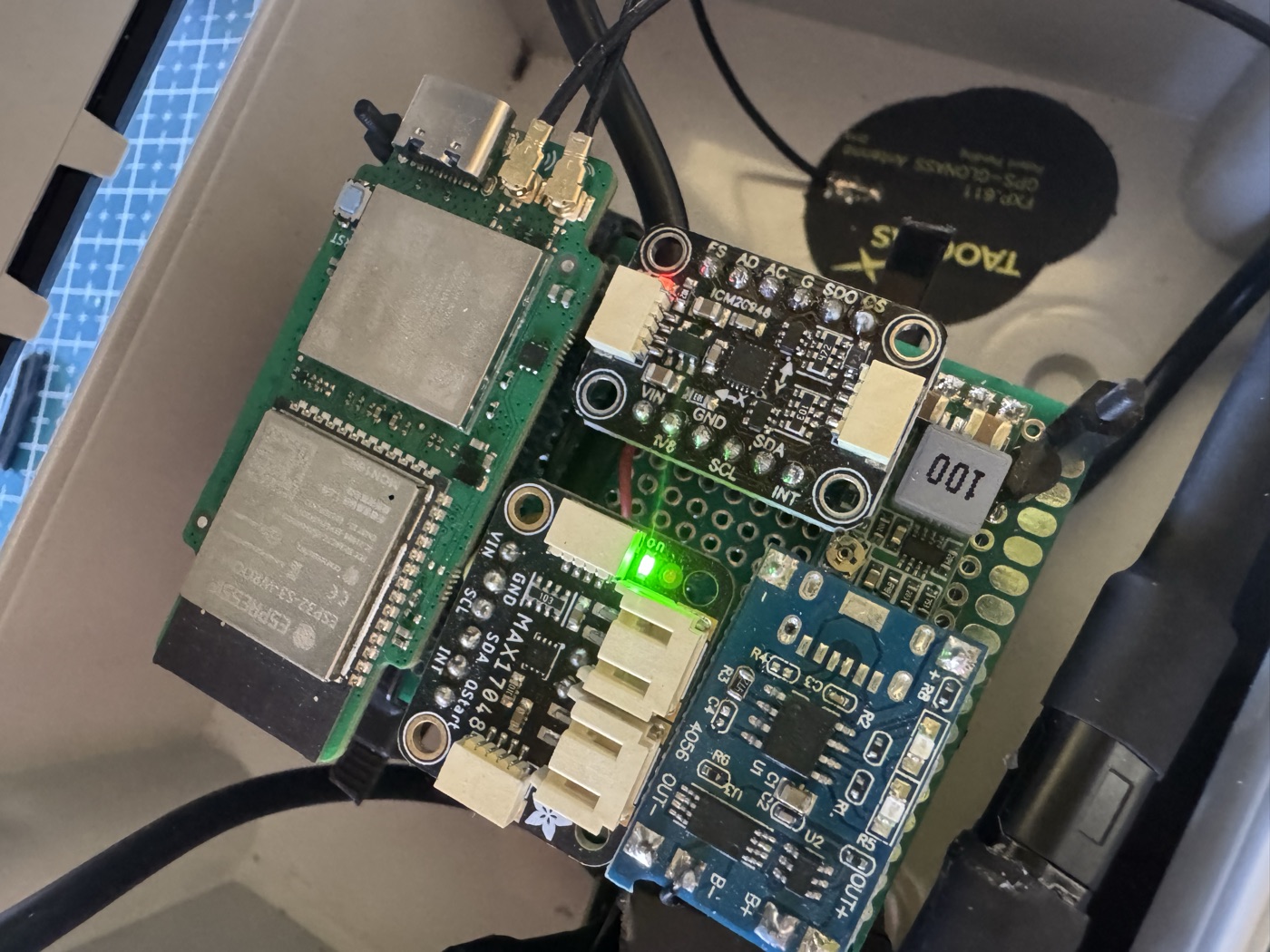
The cast
- The brain. An ESP32 processor with a cellular modem on the same board. It sleeps almost all the time and wakes every fifteen minutes to record, think, and phone home. One whole wake costs a few thousandths of the battery.
- The inner ear. A motion sensor read five times a second. This is the part that actually feels the sea. Waves are measured, not modelled: 1,024 samples per recording, 205 seconds of real bobbing, turned into a wave spectrum right there on the buoy.
- The accountant. A battery fuel gauge that tracks the cell's charge and, more usefully, its charge rate. Half our best detective stories start with this little chip noticing something.
- The sun handler. A solar charge controller fed by a 1.2-watt panel in the lid, with a protection circuit that cuts the battery off before any harm. The firmware adds manners on top: charging pauses near the top of the battery, because lithium cells live longest when they're not held at full.
- The thermometers. Waterproof probes for sea, hull and battery pack, all sharing one wire. The sea one is the number you see in the app. The other two are for us.
- The compass to home. A GPS patch, used in careful sips. Position is only interesting when it changes, and there's a whole post about that.
The opinions
The hull is sealed for good. No connectors through the wall, no hatch to corrode. Everything leaves by radio and everything arrives by radio, including entire firmware updates. That one decision drives most of the engineering: the radio budget is precious, so a night of data travels in kilobytes and a firmware update travels as a 20 KB patch instead of a 1.3 MB file.
And the honesty rule: the panel is 1.2 watts because that's what fits. That makes winter power tight by design, so the firmware knows how to slow itself down when the sun sulks, rather than pretending the problem doesn't exist.