You can see a lid opening from the battery data
During bench week the battery telemetry did something odd: solar charging stopped dead at midday under a bright light. No fault, no alarm. The explanation was standing right next to the buoy, holding the lid.
The clue
Our fuel gauge reports the battery's charge rate in percent per hour, every check-in. All morning it had been comfortably positive, the cell happily drinking under the lamp. Then, mid-day, the rate went negative and stayed there, while the light hadn't moved.
The solar panel lives in the lid. Someone had opened the top to work on the electronics, and the moment the lid came off, the panel came off with it. The battery chart recorded the exact minute it happened. Nobody had written it down; the buoy had.
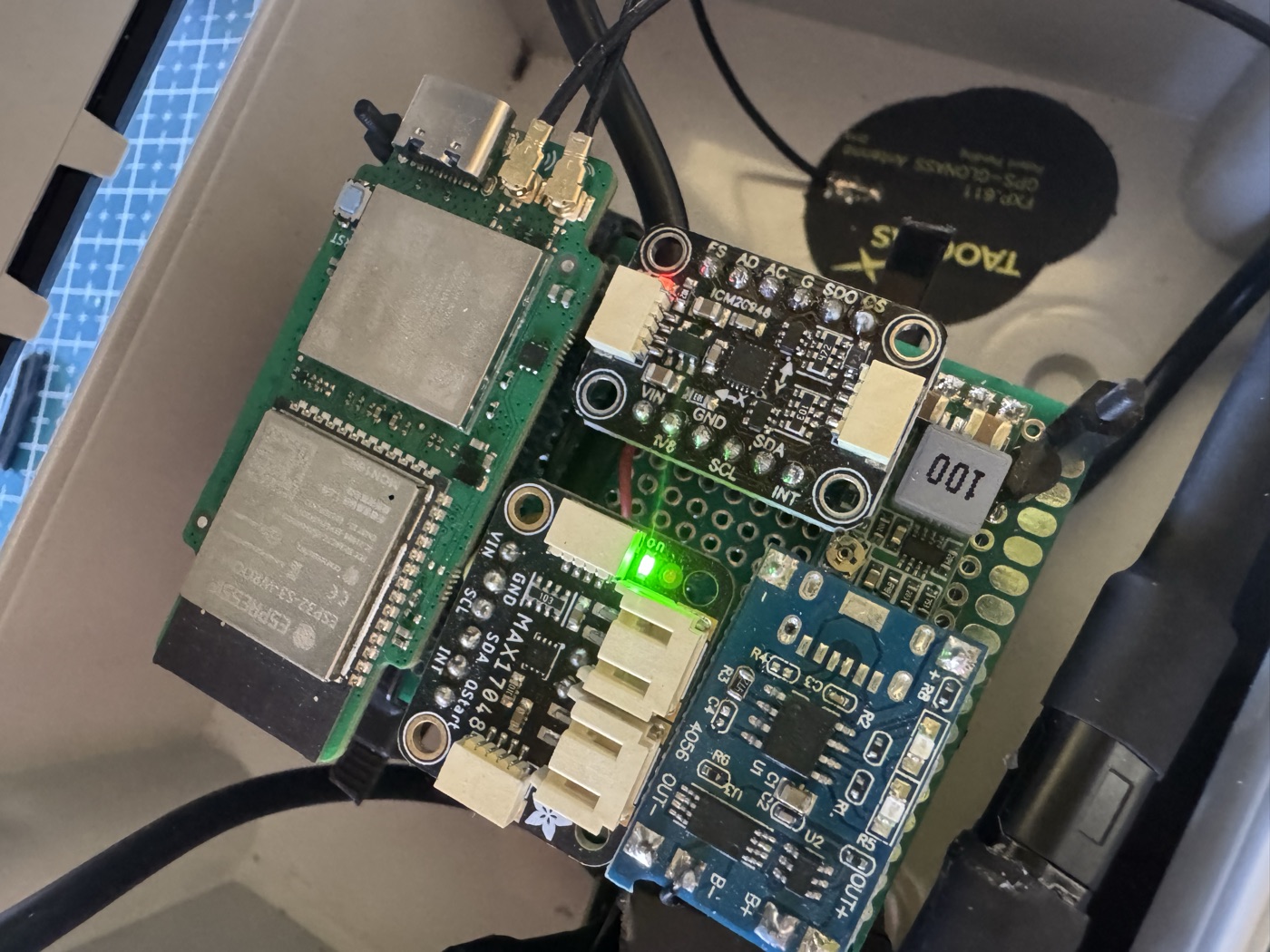
What the gauge actually knows
That one chip turns out to be the most talkative witness on board:
- Voltage and modelled charge. Not just a raw voltage guess, but a per-cell model that survives the long flat plateau where lithium voltage barely moves.
- Charge rate. The change over time is the real storyteller. Positive: sun is winning. Slightly negative at a check-in: normal, because the reading is taken while the radio is transmitting, the hungriest moment of the whole cycle. Strongly negative under bright light: something is disconnected. Or someone is holding the lid.
- Manners near the top. The firmware pauses charging when the cell reaches 4.00 V and resumes at 3.90 V. Lithium cells age fastest sitting at full; a buoy that plans to live at sea for years should top up like a marathon runner, not a sprinter.
An autonomous instrument can't have a maintenance log filled in by hand. It has to be its own maintenance log.
The pattern keeps repeating in this project: the panel found floating, diagnosed by the motion sensor. The lid off, diagnosed by the fuel gauge. If you instrument a thing thoroughly enough, it starts telling you about your own behaviour, too.