A mixing desk for the sea
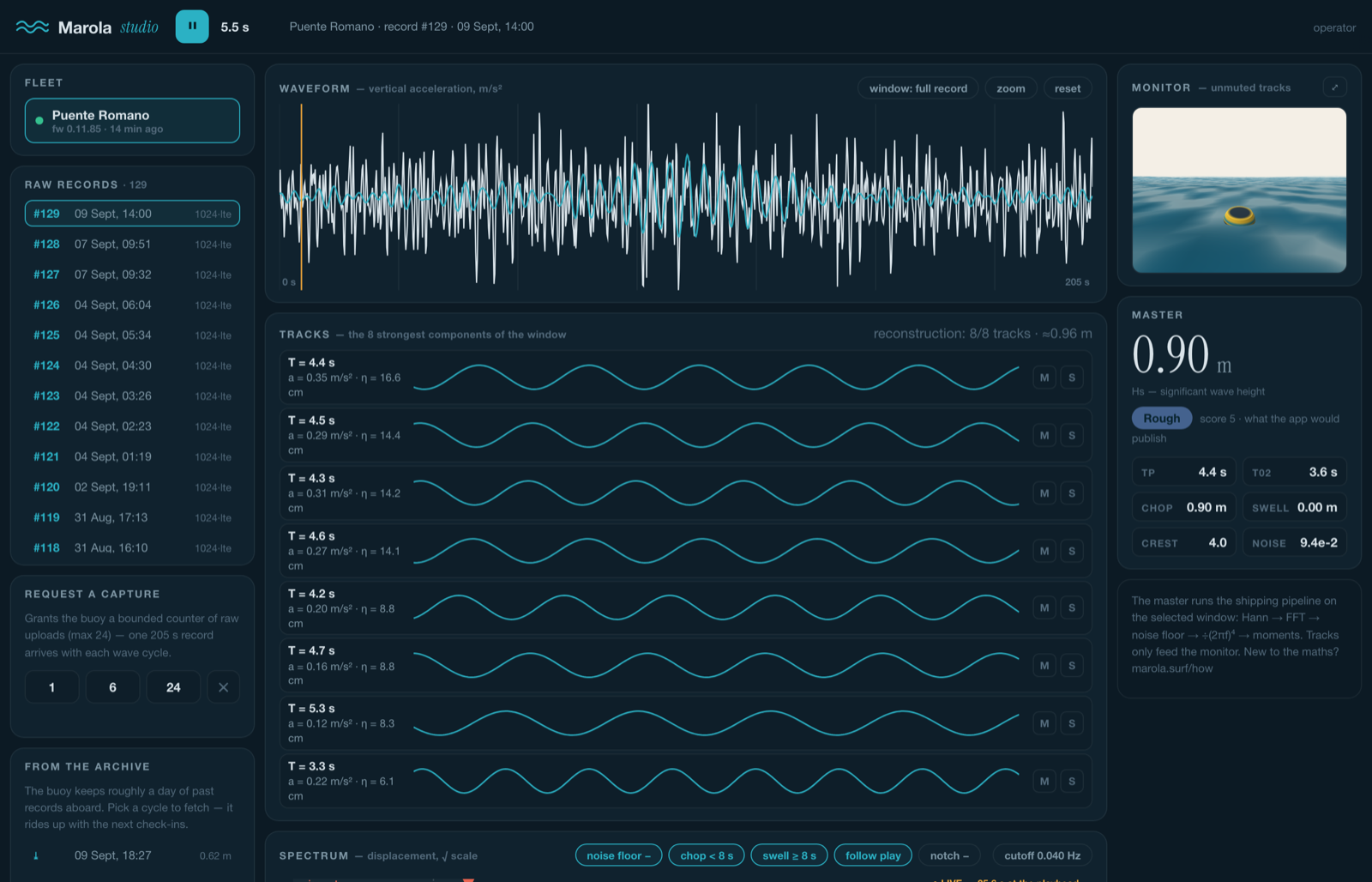
Normally the buoy boils each 205-second recording down to four numbers and throws the raw motion away. This is the tool for when four numbers aren't enough: a workbench where a recording gets taken apart like a song.
Why keep raw recordings at all?
Because every hard problem this project has had was solved by staring at raw motion. The gyroscope fault that invented phantom seas. The thumps from a neighbouring buoy. The solar panel found floating on its cable. None of those are visible in a wave-height number.
So the buoy can be granted a small allowance of full recordings to upload (a counter, never a switch, so a forgotten setting can't quietly eat the SIM card). She also keeps about a day of past recordings in her own memory. When something strange happens at 3 a.m., we ask her the next morning what the sea was actually doing, and she tells us.
What the desk does
- Tracks, like a studio. The eight strongest waves in the recording become eight channels. Solo the swell and hear the sea without its texture. Mute it and see what's left.
- A spectrum you can shove. Grab a band of wave periods and delete it from the whole signal. "What would this sea be without the 3-second stuff?" is now a drag gesture.
- Rhythm. A view that asks: does the sea repeat? It found a 15.8-second heartbeat in one recording, which is the sets arriving. Surfers know that rhythm in their bones. Now it has a number.
- The monitor. A little 3D sea rebuilt from whichever tracks you've left on, with the yellow buoy riding it. Press play and the spectrum dances along in real time.
Four numbers tell you what the sea was. The raw recording tells you what happened.
The workbench itself is our internal tool, but the ideas are all public: the interactive tour at marola.surf/how walks the same pipeline on a real recording, no login needed. And if you'd rather hear it than read it, the recordings play as music at marola.surf/listen.